PAGXXIX
Genomics in Action

PacBio will no longer be attending, hosting, or livestreaming our in-person PAG XXIX Workshop for the safety of our attendees, employees, and our communities. Sign up to receive updates for our upcoming virtual program.
Find out how HiFi sequencing is helping scientists find accurate and actionable genome-wide insights into species and populations for agriculture, conservation, and ecology.
Not able to attend PAGXXIX? Then make sure to sign-up below to live-stream the day of and receive the recording of our workshop, posters, and other materials we’ll present at the conference.
Be sure to follow along on Twitter via @PacBio and #PAGXXIX.
Sign up to receive updates for our upcoming virtual event.
Date and Time: Monday, January 10, 2022 12:50 PM - 3:00 PM
Location: Town and Country C - View Program

Presenter name, title, credentials, Preseter name, title, credentials, Presenter name, title, credentials
Presenter name, title, credentials, Preseter name, title, credentials, Presenter name, title, credentials
Presenter name, title, credentials, Preseter name, title, credentials, Presenter name, title, credentials
Presenter name, title, credentials, Preseter name, title, credentials, Presenter name, title, credentials

Jacob Brandenburg, Senior Specialist, Segment Marketing, PacBio
Long-read whole genome sequencing (WGS) for plants and animals has allowed scientists to tackle the assembly of genomes ranging in size, ploidy, and repeat content. HiFi WGS enables complete, accurate, and contiguous assemblies of even the most complex genomes. As a result, HiFi WGS has been adopted by many biodiversity genomics consortia and agriculture researchers to assemble thousands of genomes. While HiFi WGS simplifies the bioinformatics of genome assembly, library preparation remains a common challenge, especially for scientists sequencing organisms which yield low quantities of DNA or have very large genomes that require multiple libraries for a single de novo assembly.

Greg Concepcion, Staff Engineer, Bioinformatics, PacBio
With the increasing prevalence of high-quality assembled genomes, access to the pangenomes of species is now an achievable possibility for researchers with all research budgets. However, the tools to visualize, analyze, and extract actionable information from these pangenome datasets are still in their infancy. Using a large plant pangenome dataset, we evaluated the pangenome graph builder pipeline for building a pangenome graph of the species and use these evaluations to provide basic recommendations for how to best manipulate and visualize these pangenomic datasets with other downstream tools including the vg toolkit.

Presenter name, title, credentials, Presenter name, title, credentials

Presenter name, title, credentials, Presenter name, title, credentials
Monday, October XX X:00 pm PST
Lorem, ipsum dolor sit amet consectetur adipisicing elit. Nulla, aliquid? Totam nobis ad aut. Praesentium eligendi ut, sit illum ex officia, nisi voluptas ea quos dicta non exercitationem earum sed!
Lorem, ipsum dolor sit amet consectetur adipisicing elit. Eveniet quasi corporis, ut consectetur optio aut quas tempore, rerum ipsum vel eaque voluptates magnam a molestiae voluptatibus veniam quos architecto asperiores? Lorem ipsum dolor sit amet consectetur adipisicing elit. A quod deleniti, tempora reprehenderit, vel consequatur odit eveniet distinctio culpa libero ipsam? Ducimus quos amet laboriosam ut perferendis eos similique cum. Lorem ipsum dolor sit amet consectetur, adipisicing elit.
Presenter name, title, credentials, Presenter name, title, credentials
Presenter name, title, credentials, Presenter name, title, credentials
Monday, October XX X:00 pm PST
Lorem, ipsum dolor sit amet consectetur adipisicing elit. Nulla, aliquid? Totam nobis ad aut. Praesentium eligendi ut, sit illum ex officia, nisi voluptas ea quos dicta non exercitationem earum sed!
Lorem, ipsum dolor sit amet consectetur adipisicing elit. Eveniet quasi corporis, ut consectetur optio aut quas tempore, rerum ipsum vel eaque voluptates magnam a molestiae voluptatibus veniam quos architecto asperiores? Lorem ipsum dolor sit amet consectetur adipisicing elit. A quod deleniti, tempora reprehenderit, vel consequatur odit eveniet distinctio culpa libero ipsam? Ducimus quos amet laboriosam ut perferendis eos similique cum. Lorem ipsum dolor sit amet consectetur, adipisicing elit.
Presenter name, title, credentials, Presenter name, title, credentials
Presenter name, title, credentials, Presenter name, title, credentials
| # | Title | First Author |
| 2046 | Automated repeat characterization of filaggrin from PacBio Sequel HiFi long reads | A. Hawes |
| 2115 | Genomic variant detection within human segmental duplications | D. Soto |
| 2123 | High-throughput sequencing and mapping technologies applied to 10 human genomes with chromothripsis-like rearrangements | U. Melo |
| 2153 | Maximizing the quality of RefSeq annotation in the era of big data | S. Pujar |
| 2189 | Profiling variable-number tandem repeat variation across populations using repeat-pangenome graphs on haplotype-resolved assemblies | T.-Y. Lu |
| 2304 | Enlightening the dark matter of the genome: Whole genome imaging identifies a germline retrotransposon insertion in SMARCB1 in two siblings with atypical teratoid rhabdoid tumor | M. Sabatella |
| 2335 | Genome-wide profiling of DNA methylation from a breast cancer and a matched normal cell lines | C. Xioa |
| 2408 | Protective effect of 1p36.22 Ewing Sarcoma association locus is conferred by an allele specific GGAA-microsatellite duplication leading to TARDBP overexpression | S. Baulande |
| 2444 | TrueXome technology is used for true gene enrichment and pseudogene suppression | P. Song |
| 2906 | Identification of VNTR length polymorphism as a driver of local variation in DNA methylation levels | A. Martin |
| 3024 | Telomere-to-telomere assembly and complete comparative sequence analysis of the human chromosome 8 centromere | G. A. Logsdon * |
| 3207 | Long-read amplicon sequencing detects a bi-allelic SMN1 & SMN2 gene conversion allele that does not guarantee a spinal muscular atrophy (SMA) phenotype | D. Zeevi |
| 3208 | Long-read sequencing and optical mapping decipher structural composition of ATXN10 repeat in kindred with spinocerebellar ataxia and Parkinson’s disease | B. Schuele |
| 3287 | A new approach to Thalassemia and Ataxia carrier screening panels using CRISPR-Cas9 enrichment and long-read sequencing | Y. Tsai |
| 3305 | Clinical application of long-read sequencing technology to neurodevelopmental disorder diagnosis | S. Hiatt * |
| 3448 | Identifying novel structural variants at the 17q21.31 MAPT locus in progressive supranuclear palsy using targeted long-read sequencing | H. Walsh |
| 3487 | Accurate, comprehensive variant calling in difficult-to-map genes using HiFi reads | W. Rowell * |
| 3494 | Capture long-read isoform sequencing (Iso-Seq) for uncovering human isoform diversity in the brain and characterizing SARS-CoV2viral RNAs | T. Hon |
| 3512 | Full-length transcript sequencing of human and mouse identifies widespread isoform diversity and alternative splicing in the brain | A. R. Jeffries |
| 3520 | High molecular weight DNA extraction and long-read next-generation sequencing of human genomic reference standards | M. Mitchell |
| 3523 | High-throughput HiFi library workflow for Human Whole Genome Sequencing on the Sequel II System | S. Chakraborty |
| 3628 | Long read sequencing of the SARS-CoV-2 genome and the human immune repertoire | E. Tseng * |
| # | Title | First Author |
| 1062 | A high-resolution panel for uncovering repeat expansions that cause ataxias | Y. Tsai |
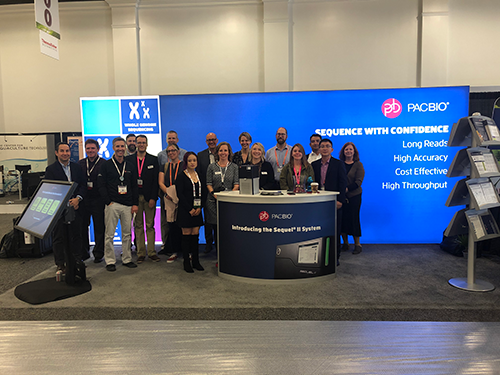
PacBio will no longer be exhibiting at PAGXXIX, but you can still book a meeting to talk to a PacBio scientist. We are excited to learn about your sequencing goals and learn more about your research!
Booth hours:
Interested in getting a sequencing project started? Stop by our service providers at PAG to talk about project design and next steps.
 |
Booth: 211 |
 |
Booth: 406 |
 |
Booth: 503 |
 |
Booth: 523 |
 |
Booth: 319 |
 |
Booth: 434 |